310-374-8047


What Causes Wash Board Roads?

Wash Board

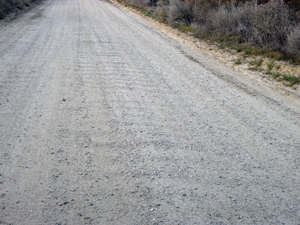
Ah, yes, another leisurely drive down a country road. You’re motoring along peacefully until suddenly bump, bump, bump, bump. Crap. You’ve hit another patch of wash board road. You know, that aggravating, teeth-jarring pattern that shakes your steering wheel and beats the bejesus out of your suspension.

“Why don’t they grade this road??!!” you yell. Well, they did some time ago. But countless cars later, the phenomenon has returned. And you get to experience the joy of riding over it.

Those annoying ripples in the road are not only irritating and tough on your vehicle. They are also hazardous at higher speeds. Special care is needed to drive on such a surface. Adding insult to injury, driving on wash board roads actually makes them worse.

What causes wash board roads

As amazing as it sounds, the wash board effect is not caused by water flowing across the surface. Wash boarding is created as vehicles drive over a surface numerous times. Dr. Keith B. Mather proved this in an experiment in 1963. He published his findings in the January 1963 issue of Scientific American.

In order to eliminate the suspension as an issue he was able to create the ripple effect by dragging a plow-like blade over sand. He determined that wash boarding occurred at speeds above 3 mph (below this speed, a deep rut was created). The principle behind it is similar to what occurs when you skip a stone over water. Each time the stone hits the water, it very briefly banks up water ahead of itself while also creating a divot-like gap behind.

As vehicles repeatedly drive over loose surfaces, any slight bump causes their tires to bank up the material ahead of the tires while simultaneously digging out behind. The result is a rippling in the road. Contrary to what you might think, driving over those ridges will not flatten them. You can minimize the effect – discussed later – but the only way to eliminate the wash board pattern is to grade the road. The pattern will return, however.

Wash boarding can occur on any loose surface. Off-road, we typically find it between the highway and the trailhead. Some areas are worse than others. Death Valley is just terrible. Ditto for many parts of Mexico.

Why wash board roads are hazardous

Beyond the simple annoyance, driving over wash board roads is dangerous and tough on the vehicle.

Many people find that driving relatively fast over the rough road helps. It does. You minimize the up and down motion of the car, but at a great risk. Understand that at higher speeds your tires are in less contact with the road as they bounce from ridge to ridge. That means only a small fraction of the tire is making contact with the road. Turning and stopping distances are reduced dramatically on an already loose surface. It’s similar to driving over a slippery surface. Add in high speeds, and you’re asking for trouble.

Your suspension, meanwhile, is taking a beating. The rapid up and down motion puts tremendous stress on the suspension and causes shocks to heat up and fail. The car may feel level to you because your suspension is taking all the abuse.

All that vibration and pounding cause bolts to loosen and parts to crack. Worn tie rod ends, worn out bushings and CV joints are possible, among other problems.

How to drive wash board roads

Most people slow down when they hit a bad patch of road in hopes of minimizing the rumbling. Unfortunately, no matter the differences in suspension, it conforms to the existing wave-like pattern and actually reinforces the wash board effect over time. Tires are packing down the soft spots and pushing dirt into the high spots. An interesting side note, Dr. Mather discovered the distance between ridges (wave length) increased directly with speed.

These suggestions will help you deal with a bad stretch of road.
  1. Air down the tires. The softer tires will give you a better grip of the road and provide more cushion. Hard tires create wash boarding faster as well.


  2. Put your vehicle in 4WD HI. This will help you deal with sliding and skidding. Remember what it’s like to drive in ice and snow. Wash boarding has a similar effect on the vehicle. While in 4WD HI you power up and turn into the slide a little bit. That will help you maintain control of your vehicle.


  3. Turn off your Automatic Braking System (ABS). The conventional brakes work better in loose material.
Another possibility, though not as safe and possibly illegal, is to drive on a part of the road that doesn’t have the wash boarding. That could be the shoulder, the opposite of the road or even a berm along the side. Having even one set of wheels on a smooth surface can make a big difference, but watch for rocks, dips, and other hazards. The biggest risk is that every now and then you run out of bank and end up in a ditch. Or there’s a rock and if you don’t see it you’ll hit it pretty hard. Slow down, and watch the road carefully.

Driving on gravel roads

While we’re on the subject of gravel roads, let’s review some safety tips.

As you know, driving on any loose surface requires extra caution. You may think that because you have large, wide tires you have unlimited traction. No so. Just like with snow, gravel offers serious challenges, especially at higher speeds.

Follow these suggestions whenever you drive on gravel.

  1. Inspect your vehicle before and after the trip for any loose parts, especially relating to the suspension system.
  2. Slow down. Because your tires aren’t gripping as well, turning and stopping distances are greater.
  3. If a tire gets caught in the soft low berm the grader leaves along the shoulder, you’re likely to jerk the steering wheel to compensate and end up flipping the vehicle.
  4. Some roads have smooth, well-worn tracks down the middle. If you drive there, be alert for oncoming traffic and other hazards. Get over to your side of the road as you approach a curve or hill.


A trip out in the country can be one of the more enjoyable ways to spend an afternoon. Knowing how to drive on unpaved roads will help keep it that way.

# # # # #


##########################

Related Articles from Badlands Off-road Adventures

Did you miss the previous article?


##########################

March 2011


  1. OAUSA Amateur Radio Testing plus Meet & Greet March 19th; more information

  2. Death Valley Adventure / Expedition -- March 25th to 28th; Click to register


##########################

Death Valley


Death Valley

The Death Valley Adventure Starts March 25th. This is a 4 day trip on the back roads in Death Valley. We will drive the Panamint Mountains, drive pass Badwater Basin (lowest spot in North America), visit Chloride Ghost town, Titus Canyon, check out Ubehebe Crater, Teakettle junction, The Race Track & Lippencott Mine Road, camp at the Warm Springs and leave via Steal Pass up to the high meadows, then take Dedeckera Canyon down to the Eureka Sand Dunes. All four days will see some light to moderate 4-wheeling. Much of the trip is quite remote with no cell service.
Check out the details and sign up on the website: http://www.4x4training.com/Adventures/Deathvalley.html


You can register directly at http://www.4x4training.com/calendar/calendar.php#Deathvalley


##########################

Mojave Road


Mojave Road

On April 9th we will follow the Old Mojave Road for 3 days. This was the earliest wagon road into California. We will run it east to west just like the wagon trains going to California in the 1800's. We will visit tons of history and see some incredible views. More Details


You can register directly at http://4x4training.com/calendar/calendar.php#Mojave


##########################


I hope to see you on the trails!
Tom Severin, President
Badlands Off Road Adventures, Inc
4-Wheel Drive School
310-374-8047
http://www.4x4training.com
Make it Fun. Keep it Safe.
#####
If you find this information valuable, please pass it on to a friend. You can forward them the email. If you received a forwarded copy of this newsletter and would like to subscribe for yourself, go to: www.4x4training.com/contacts.html and follow the instructions to join our mail list.
Want To Use This Article In Your Magazine, E-Zine, Club Newsletter Or Web Site? You are welcome to use it anytime, just be sure to include the following author/copyright information: Tom Severin, 4x4 Coach, teaches 4WD owners how to confidently and safely use their vehicles to the fullest extent in difficult terrain and adverse driving conditions. Visit www.4x4training.com to develop or improve your driving skill.

Copyright 2011, Badlands Off-Road Adventures, Inc.


Back | Phone 310-374-8047